
Installing an EV Charger at Home: What to Expect
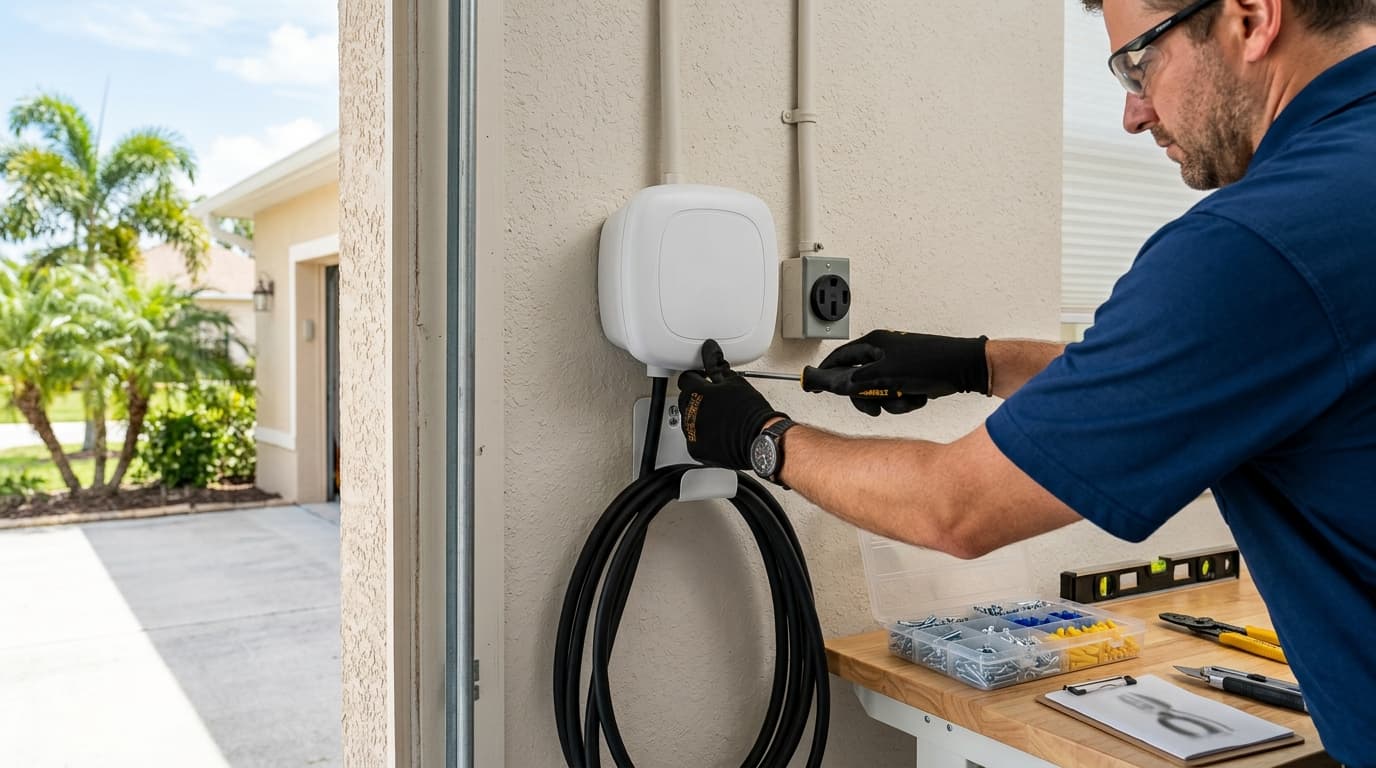
If you've just bought (or are about to buy) an EV, the standard wall outlet in your garage will technically charge it — very, very slowly. A Level 2 home charger is what makes daily EV ownership actually convenient, but the installation involves a few more steps than plugging in a new appliance. Here's what the process typically looks like.
Step 1: Confirm your vehicle's charging needs
Not every EV charges at the same rate, and not every charger outputs the same power. Before anything else, we confirm your vehicle's onboard charger capacity and your daily driving needs — someone who drives 20 miles a day has very different requirements than someone driving 80.
Step 2: Check your panel's available capacity
This is the step that trips up a lot of DIY research. A Level 2 charger typically needs a dedicated 240V circuit, usually on a 40–60 amp breaker depending on the charger. If your panel doesn't have room for a new circuit of that size, you may need a panel upgrade first — which is exactly why we check this early, before you've committed to a specific charger.
Step 3: Plan the charger location
Garage-mounted chargers are the most common setup, but driveway and carport installations are possible too, depending on your home's layout and where your panel is located. Cable length, weatherproofing (for outdoor locations), and how you'll actually park relative to the charging port all factor into placement.
Step 4: Installation day
On the day of installation, we run a dedicated circuit from your panel to the charger location, install the breaker, mount the charger, and terminate all connections to code. For most straightforward installs — charger near an existing panel with available capacity — this is a same-day job.
Step 5: Permitting and inspection
Most Volusia and Flagler County jurisdictions require an electrical permit for a new dedicated circuit like this. We handle the permit application and coordinate the inspection so you don't have to.
Step 6: Testing and walkthrough
Before we consider the job done, we run a test charge cycle to confirm everything is working correctly, and walk you through the charger's features — scheduling, any app connectivity, and basic troubleshooting.
What about charging speed?
Once installed, actual charging time depends on your vehicle's battery size and your charger's output — usually somewhere between 4 and 10 hours for a full charge on a Level 2 charger, dramatically faster than the 24+ hours a standard outlet requires. Try our EV charging time estimator to get a number specific to your vehicle and charger.
Thinking about a home charger? Request an estimate or learn more about our EV charger installation service.